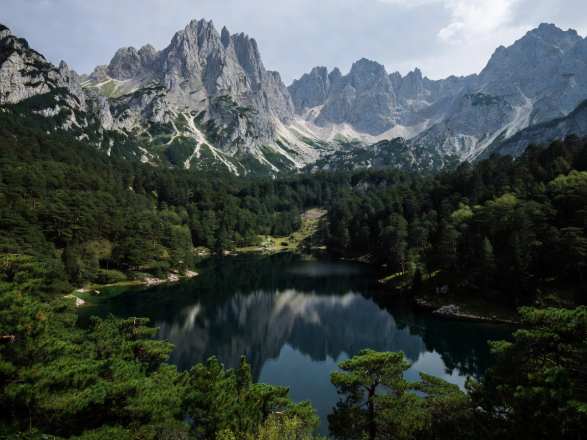
1. The Karst Hydrology of the Mountain Eyes
Durmitor National Park in northwestern Montenegro is sculpted by intense Quaternary glaciation. Its crown jewel, Crno Jezero (Black Lake), sits at an elevation of 1,416 meters at the base of the towering Međed peak. The lake is composed of two interconnected basins: Veliko Jezero (Big Lake, 26m max depth) and Malo Jezero (Small Lake, 49m max depth), connected by a narrow strait that reverses its flow during summer evaporation.
In total, eighteen glacial tarns, known poetically as Gorske Oči (Mountain Eyes), dot the massif above the treeline. Notable high-altitude tarns include Zeleni Vir (2,028m), Jablan Jezero, and the remote Srablje Jezero.
2. Technical Summit Profile: Bobotov Kuk (2,523m)
| Route Phase | Starting Altitude | Difficulty Level | Average Duration |
|---|---|---|---|
| Sedlo Pass → Zeleni Vir | 1,907m | Moderate Alpine (Class 2) | 2h 45m |
| Zeleni Vir → Bobotov Col | 2,028m | Steep Scree Ascent (Class 3) | 1h 30m |
| Final Ridge → Summit Peak | 2,380m | Exposed Karst / Fixed Cables | 45m |
3. Flora, Fauna & Karst Caves
Durmitor hosts the Crna Poda virgin forest, containing 400-year-old black pines reaching heights of over 50 meters. The massif is a sanctuary for the Eurasian brown bear (Ursus arctos), Balkan chamois (Rupicapra rupicapra balcanica), and golden eagles. At 2,180m, the Ledena Pećina (Ice Cave) preserves perpetual stalagmites formed from centuries of dripping glacial snowmelt.
Continue Exploring
Discover the expansive wetlands and Balkan Amazon of Lake Skadar.
Proceed to Lake Skadar Wetland Dossier →